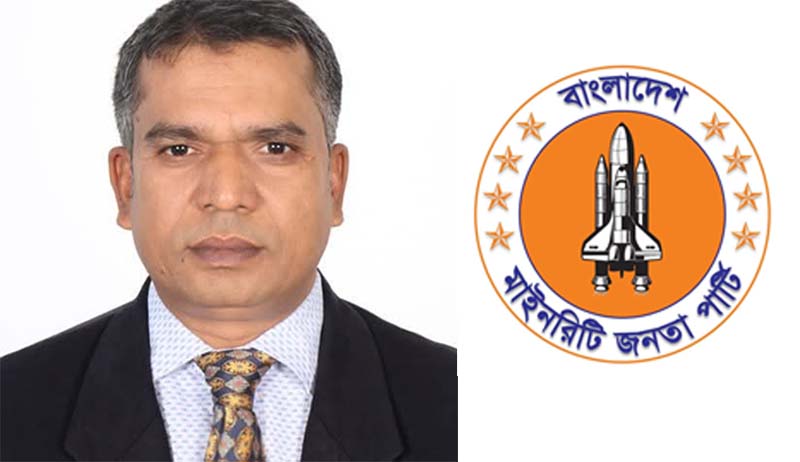
................Md. Nasir Uddin................
Constitutionally, Bangladesh is a secular, non-communal country. It is home to Muslim, Hindu, Buddhist, and Christian communities, as well as ethnic minority groups living in both the plains and the hills. These communities possess equal constitutional civic rights. They are entitled to receive all rights—including legal, administrative, judicial, political, and economic rights—equally from the state. Furthermore, people of all communities are expected to fulfill their duties toward the state, remaining bound by harmony in a spirit of equality, fraternity, and non-communal consciousness. Every citizen of this independent, sovereign state will live here with their primary identity simply as a citizen. There should be no identity defined by minority or majority status. No fear, intimidation, or insecurity should act as an obstacle to the living conditions of any community.
However, "in reality, the overall picture of the country does not reflect this." Before analyzing this statement, it is useful to look at the proportional ratio of the country's population based on communities.
According to the primary count of the 2022 census by the Bangladesh Bureau of Statistics (BBS), the country's population stood at 16,51,58,616. The adjusted integrated population is approximately 16,98,29,000. The 2022 final national report by the Bureau of Statistics states the percentages of the population based on religion as: Muslim 91.08% (i.e., 15,04,22,600 people); Hindu 7.96% (i.e., 1,31,44,204 people); Buddhist 0.61% (i.e., 10,01,974 people); Christian 0.30% (i.e., 4,88,538 people); and Others 0.06% (i.e., 1,01,225 people). According to the primary report of the 2022 census, the ethnic minority population is 16,50,159.
According to the projections of the United Nations' World Population Prospects 2024, the population of Bangladesh as of July 1, 2026, is approximately 17,78,18,044. Based on the Bureau of Statistics' 2022 census, the ethnic minority population in the 3 hill districts is 9,20,000, while the ethnic minority population across 50 communities in the plains stands at 7,30,230. According to the World Bank's evaluation, as of October 30, 2026, the poverty rate in the country is 22.5%, amounting to nearly 40 million (4 crore) people, with the extreme poor numbering around 18 million (1.8 crore).
This means that out of a total population of nearly 180 million (18 crore) in the country, the number of religious minority communities exceeds 20 million (2 crore), and the poor, extreme poor, and underprivileged people account for nearly 60 million (6 crore). Therefore, combining the religious minorities with the poor, extreme poor, and marginalized populations, the total number of minorities in the country exceeds 80 million (8 crore).
The logical reason for presenting these statistics is to highlight how this data connects with the Bangladesh Minority Janata Party (BMJP), a political party registered with the Bangladesh Election Commission.
In the constitutional definition of BMJP, it is stated that 'minority' means: religious and ethnic minorities—including Hindus, Buddhists, Christians, and indigenous/ethnic communities of the hills and plains—as well as all persecuted, oppressed, exploited, and rights-deprived people.
Therefore, constitutionally, BMJP is not a political party formed solely with religious minorities, nor does it practice politics exclusively for them. All citizens of the country who are deprived of civic rights, exploited, oppressed, persecuted, poor, and underprivileged are also considered minorities. BMJP provides political representation for all of these minorities as well.
In that sense, BMJP does not just practice politics to protect the civic rights of the country's 20 million-plus religious minorities; the party has been providing direct political leadership to secure the civic rights of 80 million minority people, including both religious and marginalized minorities.
Organizationally, BMJP and the leaders of this political party are broadly facing two challenges in their political journey:
Preventing Emigration: Creating an environment of communal harmony to build resistance against the migration of religious minorities, especially the Sanatan Hindu community, out of the country.
Ensuring Equal Rights: Securing civic rights, establishing the rule of law, ensuring justice, and guaranteeing an environment of equal rights for all marginalized minority communities deprived of civic privileges.
This matter demands a clearer explanation. In that regard, during both the pre-independence era (the Pakistan period) and the post-independence era (the Bangladesh period), the minority communities of this country, especially the Hindu community, have migrated and continue to migrate away. By reviewing the statistics of this minority emigration, one can comprehend how deep BMJP's political challenge truly runs.
Historically, to understand the changes or migration of the religious minority population in Bangladesh, analyzing the population-based data of 1951, 1961, 1974, 1981, 1991, 2001, 2011, and 2022 is essential. In 1951, during the Pakistan era, Hindus constituted 22 percent of the total population of East Pakistan, Buddhists 0.7 percent, and Christians 0.3 percent. The total population ratio of these three minority communities was 23 percent. In 1961, this decreased to 18.5 percent for Hindus, 0.7 percent for Buddhists, and 0.3 percent for Christians, bringing their total population to 19.5 percent. In 1974, Hindus were 13.5 percent, Buddhists 0.6 percent, and Christians 0.3 percent. Their total population stood at 14.4 percent. In 1981, Hindus were 12.1 percent, Buddhists 0.6 percent, and Christians 0.3 percent. Their total population stood at 13 percent. In 1991, Hindus were 10.5 percent, Buddhists 0.6 percent, and Christians 0.3 percent. Their population stood at 11.4 percent.
In 2001, Hindus were 9.3 percent, Buddhists 0.7 percent, and Christians 0.3 percent. Their total population stood at 10.3 percent. In 2011, Hindus were 8.54 percent, Buddhists 0.62 percent, and Christians 0.31 percent. Their total population stood at 9.47 percent. In 2022, Hindus were 7.96 percent, Buddhists 0.6 percent, and Christians 0.30 percent. Their total population stood at 8.86 percent.
An analysis of these statistics shows that the population of the traditional Hindu community has been continuously declining. It has dropped from 22 percent to 7.96 percent. In other words, they are disappearing, migrating. Why are the people of the country's Hindu community continuously migrating? Various studies have shown that Hindus have left the country at different times due to the 1947 partition, political instability, insecurity, property disputes, and in search of economic opportunities.
Ensuring the religious, civic, economic, social, and political security of the aforementioned religious minority communities, as well as oppressed, persecuted, exploited, and deprived individuals and ethnic groups, is now a major challenge. Considering this challenge, the Bangladesh Minority Janata Party (BMJP) began its political journey. Religious minorities, along with individuals, groups, and the 80 million marginalized and backward minorities, must become partners in this journey. They must unitedly come under the umbrella of the BMJP. An apex body must be created centering around the BMJP. While showing the highest respect for independence and sovereignty, they must fulfill their duties and responsibilities towards the state and become aware of realizing their civic rights. Minority ethnic groups must remember that due to various reasons, the state may not step forward to protect their rights—it should be assumed that it will not. In that case, they must display their united strength to reclaim their rights from the state. The faster they can unite under the same umbrella and make their collective voice reach the state, the sooner they will succeed in achieving their desired civic rights through safety and protection. May global unity and integrated humanism triumph.
Author: Journalist and Central Joint Secretary General,
Bangladesh Minority Janata Party (BMJP
BMJP Can Be the Top Political Organization in Protecting Minorities