NEWS Desk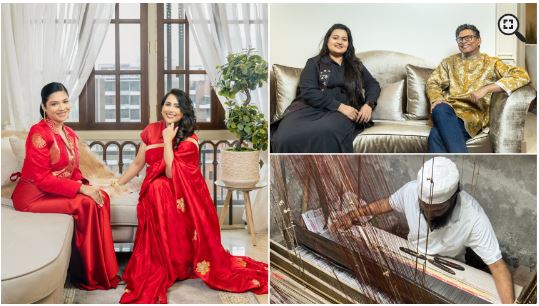
A small device is helping Bangladesh’s handloom Katan break free from repetition.For generations, Katan and Benarasi weaving in Bangladesh have been defined by remarkable craftsmanship—and by an equally persistent limitation. The traditional Jacquard punch-card system made creating larger motifs, changing their placement, or weaving fabric beyond the conventional saree format an expensive and laborious process. As a result, the same patterns were repeated again and again, not necessarily because weavers lacked creativity, but because the loom’s preparation process left little room for experimentation.
Now, after nearly a year of research and close collaboration with weavers, a small technological innovation is challenging those limitations without changing the essence of handloom weaving.
Developed by architect and designer Tanwy Kabir of Canvas and Sheikh Saifur Rahman, consultant at Haal Fashion, Prothom alo and heritage textile expert, the device does not replace the handloom. Instead, it simplifies one of the most restrictive stages of the weaving process—Jacquard preparation—allowing larger and more varied designs while reducing material waste.
“It’s not a machine; it’s a small device—an innovation,” Rahman says. “It’s like a hearing aid; it just assists the process.”
“The weaving is still done by hand, thread by thread, on a pit loom,” he adds. “The loom remains the same.”
Rethinking the Jacquard process
Although handloom weaving appears simple, Rahman explains that producing a Katan saree involves around 13 separate stages, from purchasing yarn to degumming it. One of the most demanding steps is preparing the Jacquard.
Traditionally, a design must first be drawn, graphed, digitised and then translated into hardboard punch cards—known locally as patti or mala—which are installed into the Jacquard using hooks.
The process is slow, labour-intensive and costly. Under this system, motifs typically repeat every 3.5 inches.
“That’s why you see very repetitive motifs in Katan,” Rahman explains. “There are very few unique designs because each one requires a huge investment. A single original design could cost around Tk 1,00,000.”
Rather than eliminating this stage, the new device makes it significantly easier.
“We have not omitted a step, but we have made it technologically easier,” says Kabir. “That shift allows much larger motifs. With our designs, you can make a 30-inch or even a 40-inch design if you want.”
Breaking the long-standing size limitation means designers can now create larger anchals, oversized motifs and customised pattern placements that were previously impractical.
Kabir describes the innovation as “a small device” with a screen “much like a mobile phone.” Beyond expanding design possibilities, it also reduces dependence on graph paper and hardboard punch cards.
“We are reducing the use of this paper,” she says.
“This means we are reducing our carbon footprint,” Rahman adds.
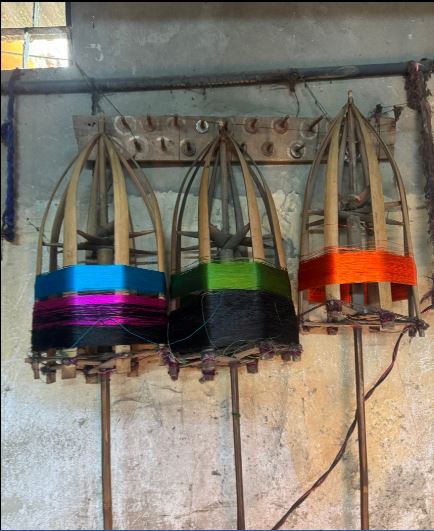
Importantly, the innovation does not replace skilled workers. Instead, it shifts labour into other specialised areas. Those previously engaged in making punch cards are also experienced in loom construction and Jacquard building. In fact, the new system requires larger Jacquard machines fitted with 2,400 hooks instead of the conventional 600 or 1,200.
“That requires a larger machine, which means more man-hours and higher wages for the builders,” Rahman says.
Built alongside weavers
The project was not developed in isolation. It evolved through extensive collaboration with weavers including Abdullah Al Shad, Md Jahangir Hossain and Abdul Kader, whose practical knowledge helped transform the idea into a working system.
Kabir says the project depended entirely on the willingness of weavers to embrace experimentation.
“This experiment would not be possible without the courage of the weavers,” she says. “They are the ones who actually make it.”
The team initially encountered considerable scepticism.
“When I first proposed larger motifs, everyone said, ‘It’s not possible. In Katan, everything is 3.5 inches.'”
The challenge, she says, was not only technical but also psychological. Years of working within the same production system had narrowed the industry’s imagination about what the loom itself could achieve.
The breakthrough came only after repeated testing and close collaboration with the weaving community.
Designing beyond the saree
For Kabir and Rahman, the innovation is about much more than making weaving easier. It is also about expanding the possibilities of Katan beyond the traditional saree without compromising the integrity of the fabric.
Both are critical of the common practice of cutting finished sarees into jackets, dresses or tops.
“A saree is a complete dress on its own,” Rahman says. “It already has a border, anchal and a visual structure designed specifically for that form. When it is cut apart, motifs are often misplaced, cropped or wasted.”
Instead, the team is weaving garments in their intended form from the outset.
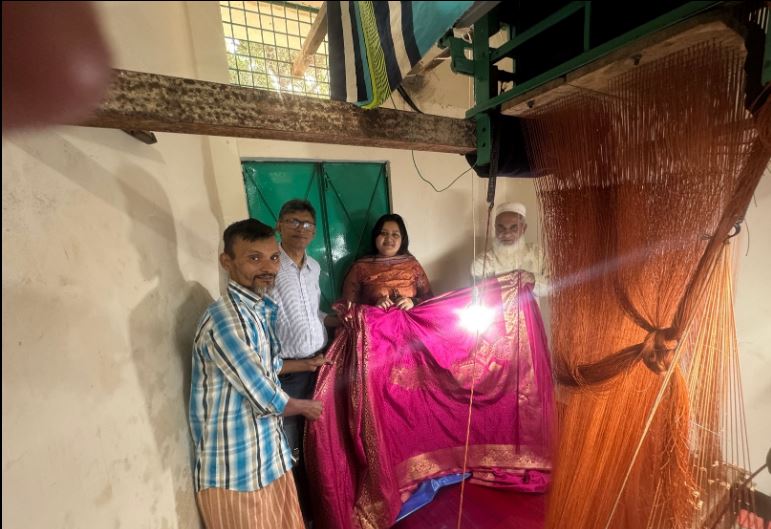
“If a dress requires three yards, we weave exactly three yards,” Kabir explains. Motifs are positioned specifically for the front, back and sleeves, allowing tailors simply to cut and stitch along predetermined lines.
Rather than repurposing an existing saree, the loom produces a woven garment kit, minimising waste while preserving design integrity.
The approach also supports Kabir’s broader ambition of bringing Bangladeshi heritage textiles to contemporary wardrobes.
“We are working to take this to a global platform,” she says. “If you only make sarees, you can’t truly reach a global audience.”
The team is now experimenting with jackets, blazers, jumpsuits, gowns and other silhouettes, aiming to “break the monotony of Katan and Benarasi by creating different patterns.”
“We want to show how diversified these fabrics can be,” Kabir says. “Whether it’s Indo-Western fusion, Western wear or traditional ethnic wear, we want to do it all.”
Yet both insist that international recognition is not the immediate objective.
“Our first goal is to make our own people understand the value,” Kabir says. “Then the rest of the world will follow.”
Revival through innovation
Ultimately, the project is about more than design innovation. It is an attempt to make the revival of Bangladesh’s heritage handloom industry economically viable.
“I want to see a revival,” Rahman says.
He envisions more people wearing Katan and Benarasi, more weavers returning to their craft and more looms operating in Mirpur.
“We want to see the number of looms in Mirpur grow from 100 to 10,000.”
His hope is to see Mirpur once again emerge as a thriving textile village and eventually position Bangladeshi heritage textiles on the global fashion stage.
Still, his priorities remain firmly rooted at home.
“We want to make our own people understand the value,” he says. “Then the rest of the world will follow.”
That ambition explains why the device matters. It is not a replacement for traditional craftsmanship but a tool that removes one of its biggest constraints. By making handloom weaving more flexible, less wasteful and more adaptable to contemporary design, it allows Katan to evolve without sacrificing its handmade identity.
Perhaps that is the innovation’s greatest achievement: not replacing tradition, but giving it the freedom to grow.
Post by News Desk