সংবাদ ডেস্ক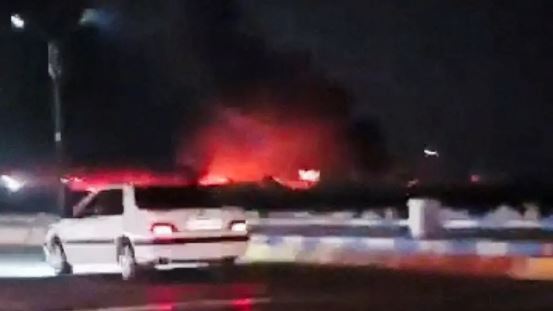
The US says it hit “over 80 targets” in its latest wave of strikes, which were in response to attacks on commercial ships in the Strait of Hormuz. There has been confirmation of strikes in the following places:
The Iranian military says coastal bases and civilian facilities were struck in the provinces of Hormozgan and Mahshar
More strikes hit Bandar Mashahr, south-west Iran – an Iranian soldier was killed by shrapnel, according to the Islamic Revolutionary Guards (IRGC)
Iranian media reported strikes in the Bushehr region of south-west Iran
The places targeted are clustered around the coastline along the Strait of Hormuz.
Map of southern Iran and the Strait of Hormuz highlighting three locations targeted in the latest US strikes on Iran: Bandar Abbas on the northern shore of the strait, Sirik on Iran’s southeastern coast, and Qeshm island. The map also shows the UAE and Oman – Iran’s neighbours to the south – and labels the cities of Dubai, Abu Dhabi and Muscat.
Kuwait says it intercepted ballistic missiles and drones
Kuwait intercepted two ballistic missiles and 13 drones overnight, according to its defence ministry.
In a statement posted on X, official spokesman Major General Saud Abdulaziz Al-Otaibi says Kuwait’s airspace was breached but the projectiles were shot down, with no injuries reported.
However, Kuwaiti authorities have since reported some power cuts. Qatar accuses Iran of ‘blatant breach’ of international law
Qatar has condemned “unjustified” Iranian attacks on Bahrain and Kuwait, which its foreign ministry says were a “blatant breach” of international law and the two countries’ sovereignty.
Doha also emphasises the need to “pursue the path of dialogue and diplomacy, to de-escalate tensions, and to build upon the progress achieved under the memorandum of understanding”.
As a reminder, Iran says it is targeting US military sites in Bahrain and Kuwait after American strikes against it overnight.
What Trump has said about the Iran talks in the past
A short while ago, Donald Trump declared the ceasefire with Iran “over”, though did leave some leeway for his negotiating team to continue talks with Tehran.
It’s not the first time the US president has issued definitive statements about the agreement – here is what he has said previously.
8 April – US and Iran sign agree to a tentative two-week ceasefire
21 April – Trump says he doesn’t want to extend the two-week ceasefire and says he “expects to be bombing” again soon. Later that day, he says US attacks have been called off after a request from Pakistan
8 May – Trump says the world will know the ceasefire is over when there is “one big glow coming out of Iran”
11 May – Days later, Trump says the ceasefire is on “massive life support”
11 June – Trump indicates the ceasefire is over, threatening to hit Iran “very hard”, before calling off the strikes later that evening
17 June – As Trump signs an initial agreement to end the war, he says: “If they don’t behave, we’ll go right back to dropping bombs right smack in the middle of their head”
8 July – Trump says the ceasefire is “over” but says negotiators on both sides can continue to talk
Attacks on tankers spark renewal of fighting in Gulf – a recap
Cargo ships seen in the Gulf near the Strait of Hormuz
Tensions have spilled over again in the Gulf, following a string of attacks on shipping in the Strait of Hormuz. It’s the worst exchange of fire between the US and Iran since they signed a memorandum of understanding (MoU) to end the conflict on 17 June. Here’s what’s happened this week.
The UKMTO says a tanker travelling through the Strait of Hormuz reported a fire after being hit by an unknown projectile
In two separate incidents, tankers report being hit in the Strait of Hormuz. Iran has not directly claimed responsibility for either of these attacks, or the one on Monday
The US military says it has “begun launching a series of powerful strikes against Iran”, hitting more than 80 targets. This is in response to attacks on commercial shipping in the Strait of Hormuz in a “clear violation of the ceasefire”, it says
Wednesday 8 July
Iran’s Islamic Revolutionary Guard Corps announces it targeted US military sites in Bahrain and Kuwait
Nato chief Mark Rutte calls the American strikes “absolutely necessary”
But Iran’s speaker Mohammad Bagher Ghalibaf accuses the US of breaching the agreement between the two countries
US President Donald Trump says that the ceasefire with Iran is “over”, telling reporters at the Nato summit in Ankara: “I don’t want to deal with them anymore, they’re scum”
Multiple strikes on the city of Bandar Abbas overnight were captured on video, with several explosions visible and flames seen rising over a facility.
It is not clear from the footage what was being targeted by the US.
Video captures strikes hitting Iran
The US military says it resumed strikes on Iran in response to attacks on three commercial vessels transiting the Strait of Hormuz.
The first ship cited by the US, Al Rekayyat, is a Qatar-owned liquefied natural gas (LNG) tanker. The nesws Verify understands it was struck by a projectile off the coast of Oman on 6 July while transiting the strait.
The impact caused a fire on board, although no casualties have been reported. The vessel crossed with its automatic identification system (AIS) location signal switched off and was last identified in satellite imagery on 22 June near Qatar’s main LNG export hub.
The second vessel, Wedyan, is a Saudi-owned crude oil tanker carrying Saudi crude. Its AIS signal has been switched off since 3 July.
The third mentioned by the US, Cyprus Prosperity, is a Liberia-flagged crude tanker which went through the strait with its location data switched on and was carrying oil to Fujairah port in the UAE.
UKMTO has confirmed three incidents but has not identified the vessels. The British maritime authority also says no casualties or environmental damage have been reported.
Post by News Desk