সংবাদ ডেস্ক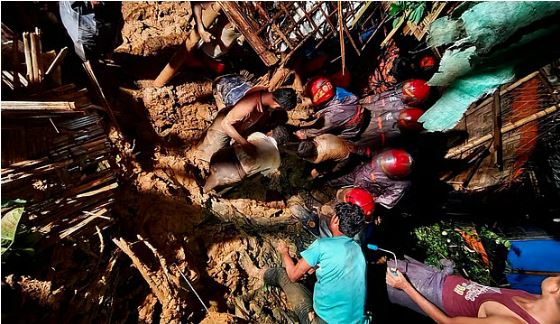
Four bodies—two women and two young children—lay side by side on the floor of a small tarpaulin-covered shelter, wrapped in blankets and towels. Several men and women stood nearby, looking on in grief. Among them, a woman wept as she said, “They went to sleep together that night. They never woke up.”
It was later learned that the family had fled to the Balukhali refugee camp a year and a half ago to escape gunfire and shelling by the Arakan Army. They had built a makeshift home on a hillside.
Monday morning was marked by mourning and fear at the Balukhali refugee camp in Ukhiya, Cox’s Bazar. Eight people were killed in landslides triggered by heavy rainfall across three refugee camps. Between 1:00 a.m. and 3:00 a.m. on Sunday night, four separate landslides struck Balukhali, Kutupalong, and Jamtoli camps. In Balukhali alone, four members of the same family lost their lives.
The deceased were Umme Habiba, 27, and Tanzina Akter, 13—daughters of Rohingya refugee Abdur Razzak—and Umme Habiba’s two sons, five-year-old Md. Rihan and three-year-old Harunur Rashid.
At the Balukhali camp on Monday morning, around 10 to 15 shelters in Block C-11 had been destroyed by the landslide. Built at the foot and on the slopes of a hill, the shelters were buried when heavy rain loosened the soil. Although Fire Service rescue workers had completed their search, the devastation remained clearly visible.
Rohingya community leader Kamal Ahmed said that Abdur Razzak and other male members of the family were still missing after the disaster. His two daughters and two grandsons were killed, and their bodies had been recovered.
According to Kamal Ahmed, Abdur Razzak was originally from Sikdar Para in Myanmar’s Rakhine State. About a year and a half ago, he fled persecution by the Arakan Army, crossed the Naf River with his family, and sought refuge in Teknaf before moving to the Balukhali camp. Unable to obtain an officially allocated shelter, his two daughters built a small tarpaulin hut beneath a hillside in Block C-11. At around 3:30 a.m., a landslide buried the shelter, killing all four occupants. Although they had escaped conflict in search of safety, they could not escape tragedy.
Rohingya residents desperately dug through the mud in search of people trapped beneath the debris.
Around 70,000 Rohingya have been living in the Balukhali camp for the past nine years. Most shelters are made of bamboo, wood, and tarpaulin and are built on steep hillsides. Over the past year and a half, another 5,000 refugees have settled there, many crowding into relatives’ shelters due to the shortage of officially allocated housing.
An additional 150,000 newly arrived Rohingya are staying in camps including Kutupalong, Madhurchhara, Lambashia, Nayapara, Jadimura, and Shalbagan. Many have been forced to build homes on unstable hillsides because no formal shelters are available.
Syed Nur, a Rohingya leader in the Madhurchhara camp, said heavy rain had continued since Sunday morning, causing large cracks to form in the hills. Rainwater seeped into those cracks, triggering landslides that buried homes as torrents of water rushed downhill.
Dollar Tripura, an official of the Ukhiya Fire Service and Civil Defence Station, said that at least eight Rohingya refugees—including women and children—were killed and two others injured in multiple landslides between 1:00 a.m. and 3:30 a.m. in Balukhali, Kutupalong, and Jamtoli camps.
Besides the four deaths in Balukhali, Kamal Hossain, 44, his wife Humayra Begum, 39, and their four-year-old son Mohammad Anas were killed when another landslide struck their shelter in Block D-6 of Camp 15 in Jamtoli.
Rohingya leader Akhtar Kamal said the hillside collapsed onto Kamal Hossain’s home around 1:30 a.m. while the family was asleep. Local residents recovered the three bodies from the debris, while two other family members were injured and taken to hospital.
At around 2:00 a.m., another landslide in Block D-7 of Camp 7 in Kutupalong killed seven-year-old Md. Ekram, the son of Rohingya refugee Rashid Ullah.
Elsewhere, a landslide in the Chattarghona area of Pahartali in Cox’s Bazar town killed a man named Ali Akbar early Monday morning and injured two members of his family.
By noon on Monday, Cox’s Bazar had recorded 267 millimetres of rainfall over the previous 24 hours. Assistant Meteorologist Abdul Hannan warned that heavy rain was expected to continue for another two days, increasing the risk of further landslides in both the refugee camps and the surrounding hills.
Mohammad Mizanur Rahman, the Refugee Relief and Repatriation Commissioner (RRRC) and Additional Secretary, said heavy rainfall had triggered multiple landslides across the camps. He described the deaths of eight Rohingya refugees, including women and children, in a single night as heartbreaking. One of the affected families had arrived only a year and a half ago but had never been allocated official shelter.
He added that about 1,000 Rohingya living in the most dangerous areas had already been relocated to safer places, with several thousand more expected to be moved as conditions required. Authorities are also conducting awareness campaigns throughout the camps to help prevent further loss of life.
Post By News Desk